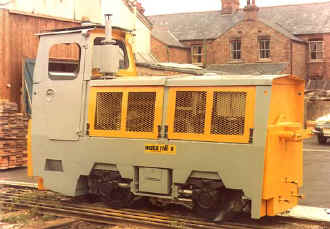
A U-series destined for Fiji.
U-Series
A U-series destined for Fiji.
The U-Series was a great change in
design for Motor Rail, brought about by the South African take-over; it was the
first production type to use hydraulic transmission. Originally known as the
Type 10, the first U-Series locos were built for INCO (International Nickel Co.)
of Canada in 1966, with an order of three going initially and being followed by
a further order for thirty units a year later.
These first locos were fitted with
hydrokinetic transmission (using a Brockhouse torque converter) and Dorman 4DA
engines. As will be seen from the table, a great variety of engines and
transmission options were used over the years. The U-Series was simple to drive,
with just one lever controlling the direction, engine speed, and air brakes.
Air brakes were an optional fitting and a screw-operated hand brake was
the usual system. The U was produced in weights from 5 Long Tons to 10 Long
Tons.
A look at the driver's controls can
identify the type of transmission fitted to a loco. The hydrokinetics have what
looks like a gated gear lever and the hydrostatics have a simple swinging lever.
Also, the hydrostatic motor can be seen between the frames on one side of the
loco.
U-Series locos had various innovations used on them such as radio control, which was fitted to the 123U type. The radio control used a portable pack that was fitted to the driver's waist and was suitable for underground use due to a guide wire that was slung from the roof of the roadway and formed an inductive loop between the locomotive and the operator's aerials. This system meant that there was no loss of signal around corners. The driver always had to be within a few feet of the guide wire, and as such the system also incorporated a "dead man's" facility. 116U038 was fitted with a different form of remote control for use in the Canadian mining industry. This system transmitted its signals directly through the rails.
|
Type |
Engine | Transmission |
| 110U | Dorman 4DA | Hydrokinetic |
|
111U |
Dorman 4DA | Hydrokinetic |
|
112U |
Dorman 4DA | Hydrokinetic |
|
114U |
Ruston 3YDA | Hydrokinetic |
|
115U |
Dorman 4DA | Hydrostatic |
|
116U |
Dorman 4DA | Hydrostatic |
|
117U |
Deutz F4L912 | Hydrokinetic |
|
118U |
Deutz F6L912 | Hydrokinetic |
|
119U |
Dorman 4DA | Hydrostatic |
|
120U |
Deutz F4L812 | Hydrostatic |
|
121U |
Deutz F4L812 | Hydrostatic |
|
122U |
Dorman 6DA | Hydrokinetic |
|
123U |
Deutz F4L812 | Hydrostatic |
|
124U |
Dorman 4DA | Hydrokinetic |
|
126U |
Deutz F4L912 | Hydrostatic |
The F4L812 engined machines were
for underground use. Other Deutz engined machines were for surface use.
Types 110U-114U had Brockhouse
torque converters; other Hydrokinetics had Twin Disc manufacture 400 series
torque converters.
All hydrostatic transmissions had Dowty "Dowmatic" variable displacement hydraulic pumps and Ruston motors.
"In about 1975
we had a problem on the U-Series hydrostatics for Canada, where a batch of
motors all started blowing their end caps off. Rustons said it was nothing to do
with them and it must be to do with the pressure limits being exceeded by
momentary peak pressures under braking. We couldn't measure these peaks with our
equipment so The Cranfield Institute of Technology got involved. We instrumented
and tested a loco at Bedford, but we couldn't get anything like the peak
pressures quoted. So we took the loco to Leighton Buzzard and coupled it up to a
train of loaded skips on a downhill gradient. In order to generate the pressure,
it was necessary to get the train going and then use the hydraulic brake
suddenly to stop the loco wheels. The loco was wired up with about 49
transducers and a solid cable to the Cranfield instrument box.
It was a cold and wet day and before we were really ready, someone volunteered to give it a try. He set off down the gradient and slammed the brakes on. A couple of us ran alongside feeding out the cable. Although the brakes worked perfectly as predicted, with the weight of the train, the wet rails and the gradient the wheels locked solid, the loco started to skid and the whole train carried on down the hill. We kept feeding out the wire until there was none left to feed out. Then the inevitable happened, the cable snapped. We had to solder 49 pieces of wire back together on site. In the end it turned out to be nothing to do with these pressure peaks. Our inspector went over to Rustons and discovered that the bearings in the motors were not being shimmed-up properly."
John Palmer (Ex-Simplex employee)
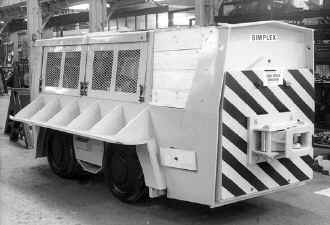
A cabless U-series fitted with side plates for use with 'Rockflo' wagons.