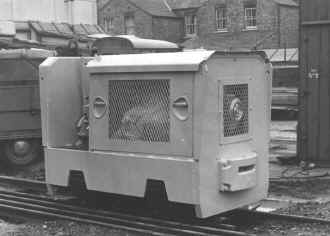
101G locomotive in the works yard at Bedford.
G-Series
101G locomotive in the works yard at Bedford.
At the time of the introduction of
the G-Series in 1968, the two smallest locos in the Motor Rail range were the 15
H.P. Mini and the more traditional 40S. The G-Series was designed to meet the
requirements of the State Mining Corporation of Ghana whose specification for
new locomotives fell between these types. The G proved to be a success and
became a standard part of the range, with the Mini locos being dropped. The
first G's (100G and 101G types) were fitted with Enfield HO.85 air-cooled
engines of 15 H.P. with a single plate dry clutch, coupled to a reversing
gearbox by means of a belt (with the exception of 100G032 & 033, which used
chains). Final drive to the axles was by roller chains. The 101G was 4-in longer
than the 100G to give extra space in the cab. The 102Gs had Enfield's HO.100
(Horizontally Opposed) 2-cylinder diesel engines of 21 H.P. The 103G and 104G
had redesigned frames and bodywork, with the 103G having Petter's PJ2 engine of
either 15 or 20 B.H.P. and the 104G using the Indian made 20 B.H.P. Kirloskar
RA2 engine. The 105G was the only G
type to use a water-cooled engine, this being the Petter PJ2-W. Weights ranged
from 2 to 3 Short Tons.
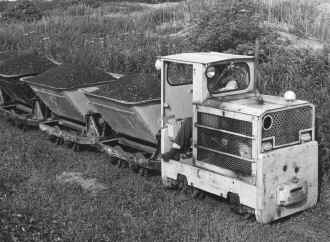
104G loco at Severn-Trent Water's Newstead works.
The majority were exported but
eight were used in the UK by British Rail (1), ICI (4), Severn-Trent Water (2)
and Thyssen (G.B.) Ltd. (1).
Number Series (built between 1968
and 1984)
100G 001-015, 032, 033.
101G 016-025, 027.
102G 026, 028-030.
103G 038-055, 058, 059, 061, 062, 064-081, 086.
104G 060, 063.
105G 082-085.
Note 1: 103GA078 was actually built to standard gauge for British Railways, Wolverton works.
Note 2: 103G061 and 062 were modified and renumbered from 051 and 050 respectively.
Note 3: 103G064 and 065 were modified and renumbered from 054 and 052 respectively. They were converted for underground use by the fitting of catalytic exhaust converters.