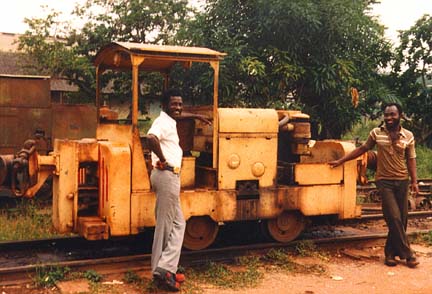
A Dorman-engined 60S at Ghana Bauxite. (Alan Keef Ltd.)
60S
A Dorman-engined 60S at Ghana Bauxite. (Alan Keef Ltd.)
The 60S was intended as the replacement to the 32/42 H.P. type and was originally known as the 50 H.P. before the introduction of the new numbering scheme. The frame was of all-welded construction and the minimum weight available was 4-Tons although extra ballast weights could be bolted to the frame ends to give weights up to 7-Tons. The 60S retained the traditional transverse engine and Dixon-Abbott gearbox arrangement of previous locos but the box was a three-speed version which gave speeds from 2 to 12 M.P.H. This enabled loads of up to 152-Tons to be hauled on the level (rolling resistance 15 lbs/Ton) in first gear according to a 1950s MR brochure. The type was initially fitted with the Dorman 3LA engine which was later replaced by the 3LB of 60 B.H.P. and then the 3LD of 72 B.H.P., all of these engines being water-cooled. Later water-cooled locos can be recognised by their smaller cab windows, which have curved aluminium frames as on the subsequent air-cooled locos.
In the mid 1970s, the 60S faced the problem of its engine no longer being produced and the company turned to Deutz for a new standard power unit Ð this was supplied in the form of the F4L912 and F4L912(W). Locomotives with the new engine were designated 60SD. The bodywork was also redesigned along the lines of the new style applied to the 40S at this time. A water-cooled engine, the Perkins 4.236, was available as an option. Only one loco was ever built with this option, this being the last Simplex built at Bedford, w/n 40SP756 despatched on 19th August 1986 to Tanganyika Sisal Spinning.
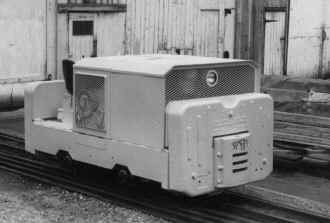
60SD 702
A batch of 10 locos fitted with Lister HR4 air-cooled engines (60SL) were built in 1980 for the Bord Na Mona in Ireland for use on their 3-ft gauge peat bog systems. These locos looked very different from any other 60S with their roomy cabs, large windows and special centre couplers. The engine covers were a cut- short version of the standard air-cooled bodywork, with a footplate and handrail for carrying tools and personnel. These locos (and other wider gauge 40S and 60S models) had inside axleboxes to allow use on 3-ft gauge with the original frame width.
Two locos were built specially for use in palm oil factories, and these were known as the 40/60SD type. They combined the frame of a standard 60S, weighted to eight Tons, with the engine (F3L912) and two-speed gearbox of a 40SD.
Number Series (built between 1955 and 1987)
Dorman Engined
11001-11027, 11029, 11031-11052, 11054-11314, 12001-12043, 12051-12060, 60S315-60S423, 60S624-60S643.
Note 1: 11001 was originally built as prototype loco 9904 with 32/42 style bodywork.
Note 2: Locos 11001-11004 had a slightly wider frame than the later production locos.
Deutz Engined
60SD701-719, 60SD724-738, 60SD752-755, 60SD757, 64SD722*, 64SD723*.
* These were the 40/60SD locos. A note in MR records states "They may be renumbered 40/60SD001 and 002".
Lister Engined
60SL740, 60SL743-750.
Perkins Engined
60SP756