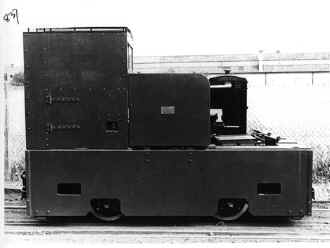
A side view of a 48/63 H.P. on the test track at Bedford.
48/63 H.P.
A side view of a 48/63 H.P. on the test track at Bedford.
These locos are sometimes referred to as 9-Ton types and there were many variations on the theme but all used the same distinctive welded frame made from 1-in. steel plate.
Only one of this type, w/n 9010 was used in Britain, the rest being exported. The engine used was the Dorman 3DL diesel engine and some individual locomotives were also recorded as 63, 65, 48/70 or 65/85 H.P. Transmission was by a 3-speed gearbox giving speeds of 3.2, 5.39 and 8.6 M.P.H. in the majority, with a few using a two-speed Simtran gearbox.
Two frame widths were used depending on the rail gauge. Locos of 2-ft to 2-ft 11-in gauge had 5-ft wide frames. Locos of 2-ft 11-in to 3-ft 6-in had a frame 6-ft wide and also had lower profile engine covers and radiator (see drawing). In the wider framed locos the conventional Simplex in-line engine and gearbox arrangement was used but this was not possible on the narrower locos. Therefore for the smaller gauges the drive from the engine was taken over the top of the gearbox to a special drop-box fitted to the outside of the gearbox. This resulted in a lower-mounted gearbox and a higher-mounted engine. A mining version was produced and was fitted with an exhaust conditioner for this purpose. The driving position on the mining version had the driver sitting further inside the frames and this, along with the exhaust conditioner and Westinghouse air brakes, made this version appear very different.
A small number of locos built to this frame type (14061 onwards) were fitted with the Dorman 4LB engine and were recorded as 85 H.P. with the final two being recorded as 85S.
Number Series (built between 1948 and 1966)
9007-9018, 9022-9035, 9040-9071, 9073-9085, 9091-9100, 14001-14019,
14023-14062, 85/9/S063, 85/9/S064.