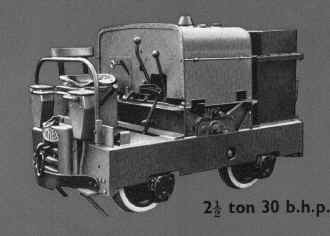
40S
This type was first introduced in
1958 and was first referred to in sales literature as the 30 H.P. type (and
40 H.P. as the power output was increased). It was not officially called
40S until the new numbering scheme of the mid 1960s. The S refers to the
original "Simplex" design, and was necessary to distinguish the type
from the new hydraulic locomotives then being introduced. For simplicity, all
marques are referred to here as 40S regardless of time period.
The 40S was the successor to and
was developed from the ubiquitous 20/28 H.P. type but used a new type of
engine - the Dorman 2LB (initially 30 B.H.P. and later 40 B.H.P.). This was
later superseded by the 2LD, developing 48 B.H.P. The frame was the same as that
used on the short welded 20/28 H.P. locos and was only 75-in long (excluding
buffer/couplers). The bodywork was also that used on some of the later
short-framed 20/28s.
The 40S was available in weights
from 2-Tons to 5-Tons with the additional weights being fixed on the ends of the
frame. Drivers of these locomotives found one drawback to the shorter frame in
that the cabs were a tight squeeze to get in to especially if the driver
concerned was, should we say, well-built.
When Dorman ceased production of
their smaller engines in the mid 1970Õs, Motor Rail had to look elsewhere for
power units for their smaller locomotives. For the 40S they had already chosen
the water-cooled Perkins P3.152 engine as an alternative to the Dorman in 1969,
later to be called the 40SP variant. Water-cooled engines were preferred where
possible due to the lucrative trade in radiator spares. The early 40SP used the
same bodywork as the standard Dorman engined version but had the key difference
of the radiator being mounted on the extreme edge of the frame (see photo).
Unfortunately, the supply of Perkins engines proved inadequate and for the 40S
the company turned to the German company Motorenfabrik Deutz A.G., whose engines
had already been used in the U-Series.
With the introduction of the new
Deutz F3L912 air-cooled diesel engine, the 40S range was cosmetically redesigned
with full-length engine covers., The new locos incorporated SD or SP in the
works number to indicate Deutz and Perkins engines respectively. The Deutz
engine developed 44 Metric Horsepower at 2000 R.P.M. Another variant of
this engine, the F3L912(W) with indirect fuel injection was fitted to locos for
underground use. This variant developed 37 Metric Horsepower at 2000 R.P.M.
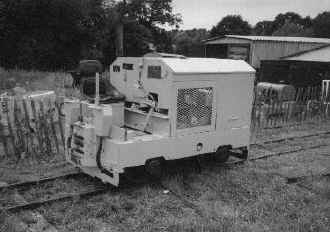
40SD529, a Deutz engined 40S.
Some 40SD locos were built with only half length engine covers after a request from Severn-Trent Water Authority, whose workshops had modified the first 40SD themselves so that a second man could be carried to stop traffic at level crossings on Severn-Trent's Minworth Water Treatment Works system. This loco was used in several SMH publicity shots but was always shown from the cab end as the unofficial modification had been carried out before SMH had a chance to photograph it.
There was one more bodywork style
fitted to the 40S, that of a one-off steam outline. Works number 22224 was given
an American "Wild West" look, complete with "boiler" and
cow-catcher for use on a pleasure railway in Wicksteed Park, Kettering. Its
overall appearance was loosely based on a Union Pacific 4-4-0 loco. The frame
was extended at the front, with a ballast weight at the rear and the engine
covers took on the appearance of a firebox.
Shortly after the announcement that
Ruston and Hornsby were ceasing manufacture of narrow-gauge locomotives in early
1968, a copy of Motor Rail's staff magazine "On the Track" announced
that the company was planning to build 40S locos fitted with the Ruston 3YWA
engine, but the first customer, United Plantations Palm Oil Estates of Malaysia,
subsequently cancelled the order and records do not indicate that any locos were
actually built with this engine.
Number Series
(built between 1958 and 1987)
Dorman Engined
22001-22260, 25011-25017,
40S261-309, 40S313-369, 40S372-449
Deutz Engined
40SD501-507, 40SD515-517,
40SD524-530.
Perkins Engined
24511, 40S310, 40S311, 40S370,
40S371, 40SP500, 40SP508-514, 40SP518-521, 40SPF522, 40SP523.
Note 1: Motor Rail records show a 4-Ton loco number 24511 with a Perkins engine and Simtran transmission built around 1960. This loco, if it was actually built would have probably used the short welded frame and so is included here in the 40S section.
Note 2: 40SPF522 of 1981 was a flameproofed loco.
Note 3: 25xxx locomotives were fitted with Simtran transmission, the first of which was delivered in 1961