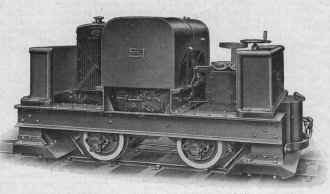
7-ton version of the 32/42 H.P. loco (2-speed box, 2RBL engine).
32/42 H.P.
The class 32/42 H.P. actually comprised two types that were built at different times with different engines but similar outward appearance - both are grouped together here under the same heading.
2RBL Engine
7-ton version of the 32/42 H.P. loco (2-speed box, 2RBL engine).
The first 32/42 H.P. types were introduced in 1932 and were illustrated in the 1932 catalogue with only a 5-Ton model being available. The first of these machines, starting at w/n 5901 was despatched on 22nd June 1932 to Joseph Boam Ltd., Middleton Towers, Norfolk for use in their sand quarries. These early locos were powered by the Dorman 2RBL diesel engine.
Number Series (built between 1932 and 1938)
5-Ton - 5901-5915, 5197-5920, 6-Ton - 5931-5933, 5-Ton - 5941-5948, 5950-5951, 7-Ton - 5949.
2DL Engine
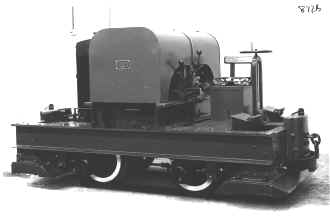
5-ton 32/42 H.P. loco as supplied to the Railway, Mine and Plantation Co.
By 1938, a new type of 32/42 H.P. loco had been introduced. This had the Dorman 2DL engine and was offered in variants ranging from 3 to 7 Tons. The new locos generally had deeper frame channels and 3-speed gearboxes with a gated gear change lever as the most obvious visual differences from the old type. The 6-Ton and 7-Ton models derived some of their extra weight from large castings bolted on top of the frame ends, which acted as a shield for the driver or shunter and formed the lower half of the drivers cab where one was fitted.
When a 32/42 H.P. loco was required for gauges over 2-ft 5-in the frame was very different and used a shallower section channel.
Note: Frame channel sizes are known to vary between 32/42 H.P. locos and this may have been due to such factors as availability of steel, rail gauge, etc.
Number Series (built between 1938 and 1958)
6522-6540, 7701-7711, 7801-7818, 7901-7999, 10001-10095, 10097-10336, 10340-10366, 10370-10457, 10464-10476.
Note: Although works number 10678 does not appear in any known company records, this loco was noted by Frank Jux under construction at the works of G. W. Bungey at Heston Aerodrome in 1954. It is possible that Bungey did erect this loco for Motor Rail or that it was a rebuild of an earlier, unidentifiable loco.