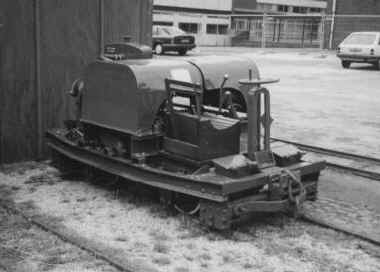
20 H.P. Loco w/n 1111 preserved by Mr John Rowlands. (D.Hall)
20 H.P.
20
H.P. Loco w/n 1111 preserved by Mr John Rowlands.
(D.Hall)
The 20 H.P. loco or “Petrol Tractor” was Motor Rail’s first loco type and is commonly known as “Bow” “Boat” or “Bent” framed, although at Motor Rail they were only ever known as “Bent” frame. The type was by no means the first internal combustion loco but was probably the first successful mass produced type. It made its mark in the First World War, when hundreds were constructed for the War Department Light Railways to operate the 2-ft (60-cm) gauge lines that were built to supply the trenches.
MRTC had tendered for the War Office contract in January 1916 after John Dixon Abbott had met the consulting engineers to the War Office, Messrs. Rendall, Palmer & Tritton. The specification was for “Petrol Trench Tractors” of 600-mm gauge, weight not exceeding 1 Ton per axle and to be capable of drawing 10 to 15 Tons at 5 miles per hour. The resulting design incorporated features that were to form the basis of Motor Rail designs for half a century such as the transversely mounted engine, driving position and the Dixon-Abbott patent gearbox.
After the war, cheap war-surplus Petrol Tractors started to open up new markets for narrow gauge railway haulage where steam locomotives were thought too heavy or just too expensive to buy and run. The Quarry of June 1919 featured an article regarding the 20 H.P. “Simplex” petrol or paraffin locomotive, which pointed out the inherent advantages of the internal combustion engine such as comparatively low first cost and economy in running. It also mentioned the flexibility of the “motor engine” as regards varying speeds and loads. Part of this read: “It is coupled to a heavy flywheel and inverted cone type clutch, which in turn is directly coupled with the “Dixon-Abbott” patent spur wheel gearbox. The combination ensures steady running and no jar when running and hauling various loads from 1 to 12 miles per hour. This makes for less wear and tear than is experienced with a steam engine of similar capacity”.
The 2JO petrol engine manufactured by W. H. Dorman & Co. Ltd. of Stafford powered the 20 H.P. loco and this choice of manufacturer was to stay with Motor Rail on and off for over fifty years.
After the war a 4-Ton version became available and this used the same engine, running gear and specification as the 2-Ton but had a straight channel frame, although it retained many features of the “bent” frame construction. Straight-framed locos were available as 2-Ton versions but only if the gauge was greater than 2-ft.
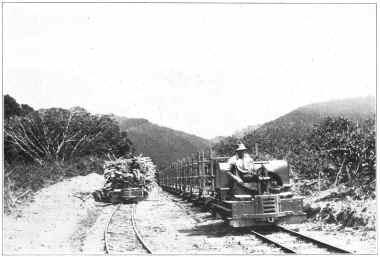
4-ton 20H.P. Locos hauling sugar cane, Cairns, Australia.
Optional fittings were available on post-war locos such as a short canopy for the driver that was fitted with tarpaulins that could be rolled down against inclement weather so as to leave a small rectangular hole for the driver to see fore and aft. A full cab of wooden construction was also available.
In 1929, a new frame type was introduced on the 20 H.P. locos, which also formed the basis for other classes that were being developed, including the 20/35 H.P. petrol, the 25/40 H.P. petrol, the 12/16 H.P. diesel, the 16/24 (58xx series) and the 20 H.P. diesel. This new frame was 7-ft 11-in long and 4-ft 10-in wide (on 1-ft 10-in to 2-ft 8-in gauge locos) and was of a much simpler construction than those used previously. 20 H.P. locos using this frame began at w/n 5001 and finished at w/n 5094. In 1930 such a loco would have cost £190.0s.0d new.
Number Series (built between 1916 and 1932)
New Locos
200-379, 842-1116, 1162-1255, 1290, 1291, 1387, 1388, 1642-1854, 1856-1859, 1892-1911, 1932-1941, 1980-2020, 2041, 2045-2060, 2075-2091, 2093-2097, 2099-2119, 2135, 2147-2150, 2152-2157, 2171, 2172, 2260, 2287-2291, 3660, 3661, 3686-3688, 3695, 3703, 3708-3712, 3715-3719, 3722-3725, 3733, 3734, 3738, 3739, 3741-3746, 3748, 3749, 3751-3774, 3792, 3832, 3833, 3838, 3851, 3883, 3971, 3972, 3978, 3991, 3993, 4001, 4006-4086, 4155, 4159-4161, 4165-4167, 4170, 4179-4183, 4199, 4203, 4214, 4501-4552, 4556-4562, 4564-4575, 4576, 4578-4580, 4587-4622.
Note 1: 1290 & 1291 were post-war built locos but these numbers had also been given to 40 H.P. locos built for the Ministry of Munitions.
Note 2: w/n 200 is the earliest recorded loco, however it is believed that this was not the first. It is possible that earlier locos used engines other than Dorman, possibly by White & Poppe.
New Numbers Given to “Reconstructed” or Overhauled Locos
Note that not all locos given new numbers were rebuilds (“reconstructed”). Sometimes a loco that was in to be re-engined or overhauled for its owners was renumbered when no trace of its original identity could be found.
2175, 2179-2214, 2216, 2217, 2292, 3650-3654, 3657, 3681-3685, 3689-3694, 3696-3700, 3704, 3705, 3713, 3714, 3720, 3721, 3727-3729, 3735-3737, 3775, 3778-3781, 3787-3791, 3794-3796, 3807-3811, 3823, 3824, 3828-3831, 3834, 3835, 3837, 3841, 3844, 3845, 3849, 3850, 3852, 3854, 3855, 3857, 3858, 3860-3879, 3881-3894, 3960-3963, 3969, 3970, 3974-3977, 3981-3990, 3992, 3994-3999, 4002-4005, 4575, 4577, 4625.
New locos built to new frame design
5001-5094