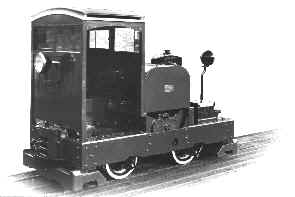
3.5 ton loco with early type (wooden) cab and electric lights.
20/28 H.P.
3.5 ton loco with early type (wooden) cab and electric lights.
The 20/28 H.P. model was
another of the so-called "plate frame" types. However, not all 20/28s
were plate framed, those over 2-ft 6-in gauge were built with straight channel
frames. The 20/28 was the most common type produced and was built between 1933
and 1960, initially being available as 2 and 3-ton variants. A 4-ton model was
added later.
The 20/28 was fitted with a Dorman
diesel engine, initially the 2HW, then the 2DW and finally the 2DWD. Initially
Motor Rail had an exclusive licence to use these engines in their locomotives.
The 2HW was built under the Ricardo licence of Messrs. Ricardo & Co.
Engineers (1927), having a flat top piston and indirect fuel injection. This
engine was fitted with heater plugs for cold starting, whereas the later types
could be started from cold without heaters.
Other optional fittings were
available as already mentioned, such as the cab etc. but the 20/28, being a
diesel, could also be fitted with an exhaust conditioner for use underground. A
cooling water circulating pump was an optional fitting for operation in hot
climates.
The basic design remained unaltered
until the mid 1950s, when a few changes were made. The most obvious of these
were a new type of axlebox, heavier chains and axles, and the fully welded
construction of the frame, this having previously been partially riveted.
Also in the mid 1950s, a new
variation of 20/28 H.P. loco was introduced mainly for mining use in overseas
markets; this was the short-framed version which introduced several features
that were to be used on the 30 H.P. (later 40S) loco including the frame,
new style radiator and a lever-operated brake. The short frame was primarily
introduced to ensure the loco could be lowered down mineshafts with small cages,
and it also allowed a greater number of locomotives to be packed into shipping
containers. The old style of engine covers was retained initially but was later
replaced with the style that would be used on the 40S. Some of the early
short-framed 20/28s had the brakes operated by a vertically mounted wheel that
was linked by means of a chain.
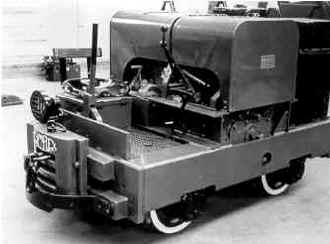
Short welded frame 20/28 H.P. loco with lever brake and old style engine
covers. This particular loco was supplied to Sweden via Carl Strom A.B.
In addition to the usual
Dixon-Abbott type gearbox, some of the late short-framed locos were fitted with
"Simtran" transmission from 1960. This system incorporated a
Vulcan-Sinclair fluid coupling and a constant mesh gearbox within which the
clutches were worked by hydraulics so that the action of the clutch and change
speed lever was operated by one lever only. There were two versions, the single
speed and the twin speed. The Simtran locos were also provided with automatic
chain lubrication, which was operated by the change-direction lever.
Number Series (built between 1933 and 1960)
5851-5889, 7101-7228, 7301-7499, 8501-8991, 9200-9359, 9362-9367, 9369-9378, 9380-9386, 9390, 9392-9395, 9397-9396, 9404, 9409-9422, 9424-9426, 9430-9431, 9433-9439, 9442, 9449-9450, 9455-9525, 9527-9548, 9551-9638, 9641-9667, 9669-9671, 9673-9678, 9681-9780, 9784-9788, 9790-9838, 9840-9851, 9853-9857, 9859-9861, 9863-9902, 9951-10000, 20001-20036, 20052-20061, 20062-20089, 20500-20510, 20531-20591, 21000-21292, 21295, 21500-21553, 21555-21575, 21578-21604, 21606-21636, 24011-24013, 24023-24026.
Note 1: 24xxx locos were fitted
with Simtran transmission, the first of which was supplied in 1960.
Note 2: 9200-9250 were locos from the 8501-8991 series, repurchased as war surplus and given new works numbers.
Note 3: 9539, 9540, 9660-9667 were second hand locos (some were 20/26 H.P. type originally), reconditioned, fitted with new engines and given new works numbers.
Note 4: Although works numbers 20511-20530 do not appear in any known company records, three locos (20511, 20515 & 20516) were noted by Pete Roberts under construction at the works of G. W. Bungey at Heston Aerodrome in 1954. 20511, 20512 and 20513 were similarly noted by Fred Pugh in the same year. It is possible that Bungey did erect these locos for Motor Rail or that they were rebuilds of unidentifiable locos which were given new numbers in the Motor Rail series.
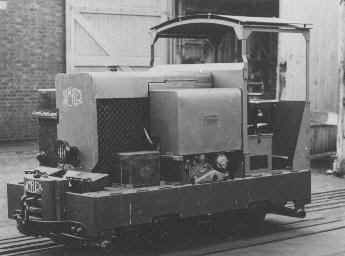
Welded frame loco with special bodywork style supplied only to Parry's of
India.