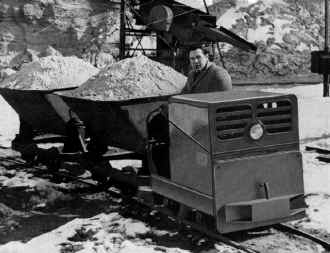
10 H.P. loco on test at a sand quarry in the Leighton Buzzard area.
10 H.P.
10 H.P. loco on test at a sand quarry in the Leighton Buzzard area.
This was the smallest type of loco
ever produced by Motor Rail and was, according to the May 1963 edition of The
Contract Journal, "specially developed for use in tunnels and mine
galleries and for applications where axle loading must be kept to a minimum."
At Bedford, it was affectionately known as the "Mini Simplex" or
"Duplex."
The power unit of these locos was
the Lister SL2 (and later SR2) air-cooled diesel engine, which produced 10 H.P.
at 2000 R.P.M. and this was coupled to an epicyclic gearbox by means of vee
belts. This gearbox gave one speed in either direction with the forward/reverse
and neutral being operated by hydraulically activated cone clutches. The brake
was cable operated to an expanding drum fitted on the final drive shaft of the
gearbox. The wheels and axleboxes were supplied by Allens of Tipton, a firm
better known for making wagons.
Haulage capacity of these locos,
that only weighed in at 1-Tons, was given as 27-Tons on the level, going down to
just 2.3-Tons on a gradient of 1 in 15.
Optional extras that could be
supplied were: electric start, electric lighting (with or without battery), cab
or canopy, exhaust conditioner (naked flame mines only). The type designation
was later changed to 12 H.P. and with the introduction of the SR engine it
was renamed 15 H.P.
Number Series
(built between 1963 and 1968)
26001-26007 (10 H.P.), 26008-26016 (12 H.P.), 26017-26022 (15 H.P.).
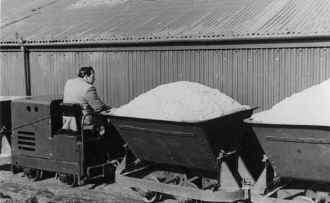
A 10 H.P. dwarfed by its load of sand filled V-skips.
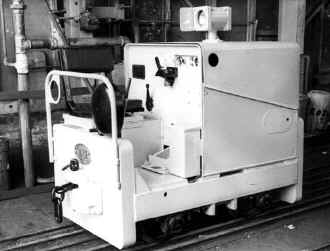
Another in the works at Bedford.