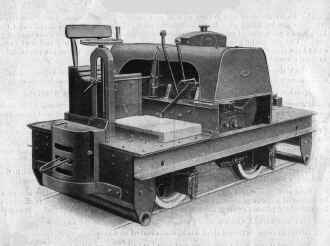
10/20 H.P. and 12/20 H.P.
The 10/20 H.P. was the first new narrow gauge petrol loco design since World War I and was one of Motor Rail’s lightest and lowest powered models, with a weight of only 2 tons. Fewer than 30 of these locos were built between 1929 and 1940, making it also one of Motor Rail’s rarer locos, although remarkably four survive in the U.K. Dorman engines powered the majority - either the 4MVB or 4MVR, both of which were initially rated at 10/20 H.P., the latter being up-rated later to 12/20 H.P. However, the last 4 built had the Austin 12/4 engine of 12/20 H.P. fitted. The Dorman engines do not seem to have been a success, as spares such as big-end bearings were ordered within a month of one loco being delivered. Some locos had their engines rebuilt several times in less than 5 years and one had a replacement engine within 4 months. Dorman-engined locos can be distinguished from later models due to the silencer being placed closer to the centre of the loco on the gearbox side of the radiator.
This series of locos incorporated a
new design of gearbox and clutch. The clutch comprised a single dry plate which
was totally enclosed within the engine flywheel. The new gearbox design was
smaller and lighter, employing ball and roller bearings throughout. The output
drive sprocket was also moved forwards, making it equidistant from the front and
rear axles. The lever positions for first and second gear selection were also
reversed in the new arrangement. All these features became the standard for
subsequent types.
Number Series
(built between 1929 and 1940)
6001-6024,
6031-6032, 6035-6036.
Note 1: 6032 was a rebuild of 6019.
Note 2: 6016 was a rebuild of 6008.
Note 3: Parts of 6020 were used in the construction of 6031 and 6035.
Note 4: 6012 was returned to Bedford in 1937 for an Austin 12/20 H.P. engine to be fitted.
Note 5: 6009 was the first loco to be designated 12/20 H.P.
Note 6: The number 6036 was allocated to George W. Bungey, possibly for an unidentified rebuild.